| Worlds in Flames: Global Conflict and Human Horror, 1900 to Present – Part Two |
Objectives:
Explain how economic collapse from the Great Depression and grievances over the Versailles Treaty fueled political extremism and undermined the post-WWI peace.
Describe why the League of Nations failed to stop aggression and how appeasement policies (especially Munich) encouraged rather than prevented Axis expansion.
Trace the sequence of aggressive acts by Japan, Italy, and Germany from 1931to 1939, culminating in the Nazi-Soviet Pact and the invasion of Poland that triggered World War II.
Outline how World War II was fought as a total, multi-front global conflict using Blitzkrieg, advanced technologies (tanks, carriers, bombers, submarines, atomic bombs), and full societal mobilization by both Axis and Allied powers.
Identify the war’s decisive turning-point battles (Stalingrad, Midway, D-Day) and recognize its worldwide scope, including massive colonial involvement and the escalation of the Holocaust during the conflict.
Unit Overview:
The era from c. 1900 to the present stands as one of the most transformative and turbulent in human history. At the dawn of the 20th century, Europe (along with powers like the United States, Russia, and Japan) dominated the global political order through vast land-based and maritime empires. Yet this dominance was fragile and challenged by rising nationalism, revolutionary ideologies, economic rivalries, and technological advances that made warfare more destructive than ever before.
This 3-part unit explores the global conflicts that dominated the era, the dramatic changes in the global political order after 1900, and the devastating mass atrocities that marked the century. Two world wars reshaped borders, toppled empires, and killed tens of millions, while the interwar years exposed the fragility of peace efforts and sowed seeds for even greater catastrophe. These conflicts were not isolated to Europe; they drew in colonies, non-European powers, and global economies, accelerating decolonization, ideological struggles, and shifts toward new forms of international organization.
Theme Day 1 examines the shifting global power dynamics after 1900 and the outbreak, conduct, and immediate aftermath of World War I: the conflict that shattered the old order and set the stage for future instability.
Theme Day 2 covers the uneasy interwar period and the descent into World War II, exploring its causes, global scale, and how new forms of warfare and total mobilization defined the deadliest conflict in history.
Theme Day 3 focuses on mass atrocities after 1900, with deep attention to the Holocaust and Britain’s specific challenges in responding to it, while connecting these horrors to broader patterns of genocide, ethnic cleansing, and the era’s ideological extremes.
Theme Day 2: The Interwar Period and the Descent into World War II
The Interwar Period (1918 to 1939) – Economic Instability, Political Extremism, and Diplomatic Failures
The years after WWI, often called the “interwar” or “interbellum” period, were marked by attempts at recovery overshadowed by deep instability. The Treaty of Versailles left unresolved tensions, particularly Germany’s resentment over reparations, territorial losses, and the “war guilt” clause.
Read p.50 about The Great Depression (and anything else you wish to read)
Economic instability:
The 1920s saw brief recovery (e.g., the “Roaring Twenties” in the U.S. and parts of Europe), but the stock market crash of 1929 triggered the Great Depression (1929 to 1939). Global trade collapsed, unemployment soared (e.g. 25%+ in the U.S. and Germany), and hyperinflation wrecked economies like Germany’s in the early 1920s. This fueled despair and extremism, as moderate governments seemed incapable of solutions.
Political extremism:
Economic chaos boosted radical ideologies.
In Italy, Benito Mussolini’s Fascists seized power in 1922 via the March on Rome, establishing a totalitarian state emphasizing nationalism, militarism, and anti-communism.
Mussolini’s ascent to power: The March on Rome Explained
In Germany, Adolf Hitler and the Nazis rose amid hyperinflation and Depression; Hitler became Chancellor in 1933 and consolidated absolute power (Enabling Act, Night of the Long Knives).
Japan saw militarism dominate, with ultranationalists pushing imperial expansion. These regimes rejected democracy and the post-WWI order.
Failure of the League of Nations:
Created in 1920 to prevent war, the League lacked enforcement power (no army) and U.S. membership. It failed to stop aggressions like Japan’s invasion of Manchuria (1931), Italy’s conquest of Ethiopia (1935), and Germany’s violations.
The League of Nations – Khan Academy
Unresolved tensions from Versailles + appeasement + Spanish Civil War:
- Germany chafed under Versailles limits.
- Britain and France pursued appeasement (yielding to aggressors to avoid war).
- The Spanish Civil War (1936–1939) served as a brutal preview.
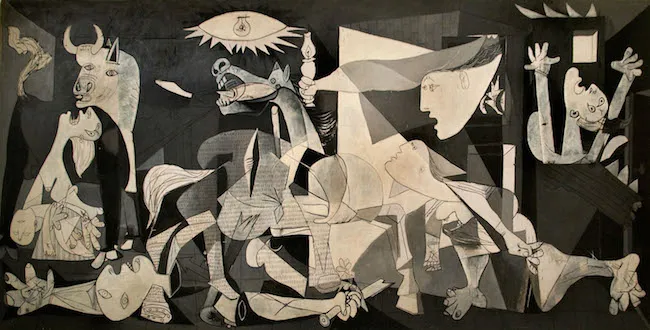
- Fascist-backed Nationalists (led by Franco) defeated Republicans, with Nazi Germany and Fascist Italy testing weapons/tactics (e.g., bombing of Guernica), while the Soviets aided Republicans.
Guernica by Pablo Picasso (1937) is a huge black-and-white Cubist painting showing the agony of civilians—screaming figures, a dying horse, a bull, and a grieving mother with her dead child. It depicts the terror of the Nazi and Italian bombing of the Basque town of Guernica during the Spanish Civil War.
Its relevance to the interwar period lies in exposing fascist aggression, aerial bombing of civilians, and the brutality that previewed the total war tactics of World War II.
Key Timeline Events:
- Treaty of Versailles signed
- Mussolini’s March on Rome
- Hyperinflation crisis peaks in German
- Wall Street Crash begins
- Great Depression
- Japan invades Manchuria
- Hitler becomes Chancellor of Germany
- Italy invades Ethiopia
- Spanish Civil War
- Anschluss
Activity 5: Timeline of Interwar Events
Put these events into this table OR create a timeline with the same information.
Causes of World War II – Aggressive Expansion, Appeasement, and the Final Triggers
This part examines how interwar instability turned into deliberate aggression by the Axis powers (Germany, Italy, Japan). A shocking diplomatic twist led directly to war in 1939. The ideological clashes of fascism and Nazism’s emphasised racial superiority, and expansion.
Aggressive Expansion by the Axis Powers
The 1930s saw unchecked territorial grabs as the League of Nations proved powerless:
Japan:
Seeking resources and empire, Japan staged the Mukden Incident (1931) to justify invading Manchuria (northeastern China), creating the puppet state of Manchukuo. This was the League’s first major failure. Japan withdrew when condemned. Full-scale invasion of China followed in 1937 (Marco Polo Bridge Incident), including atrocities like the Rape of Nanking.
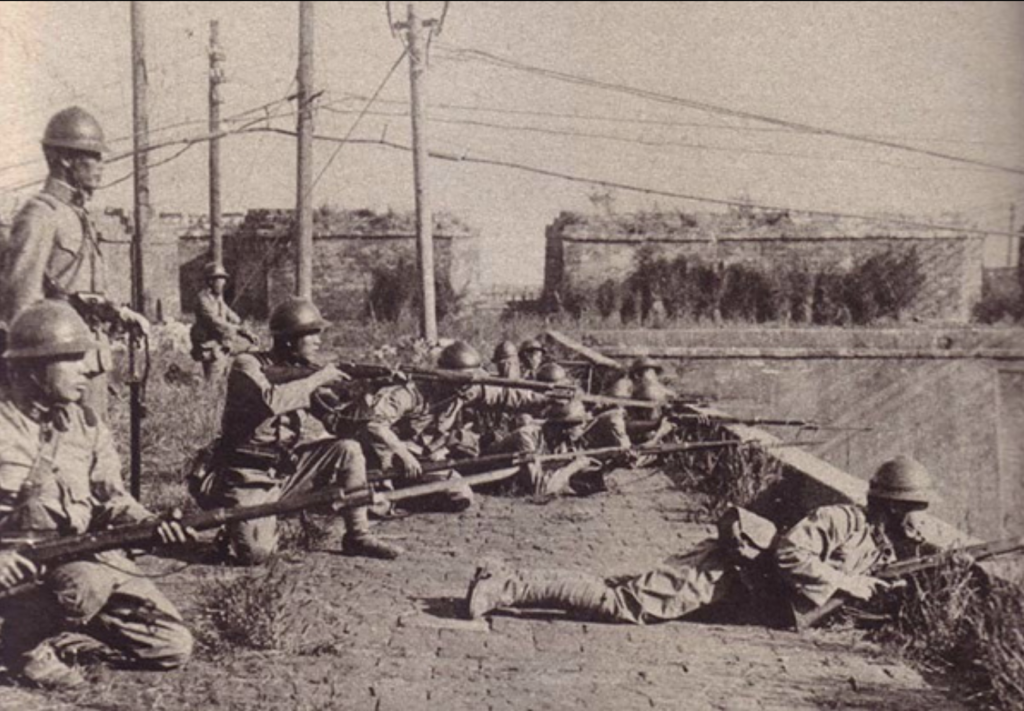
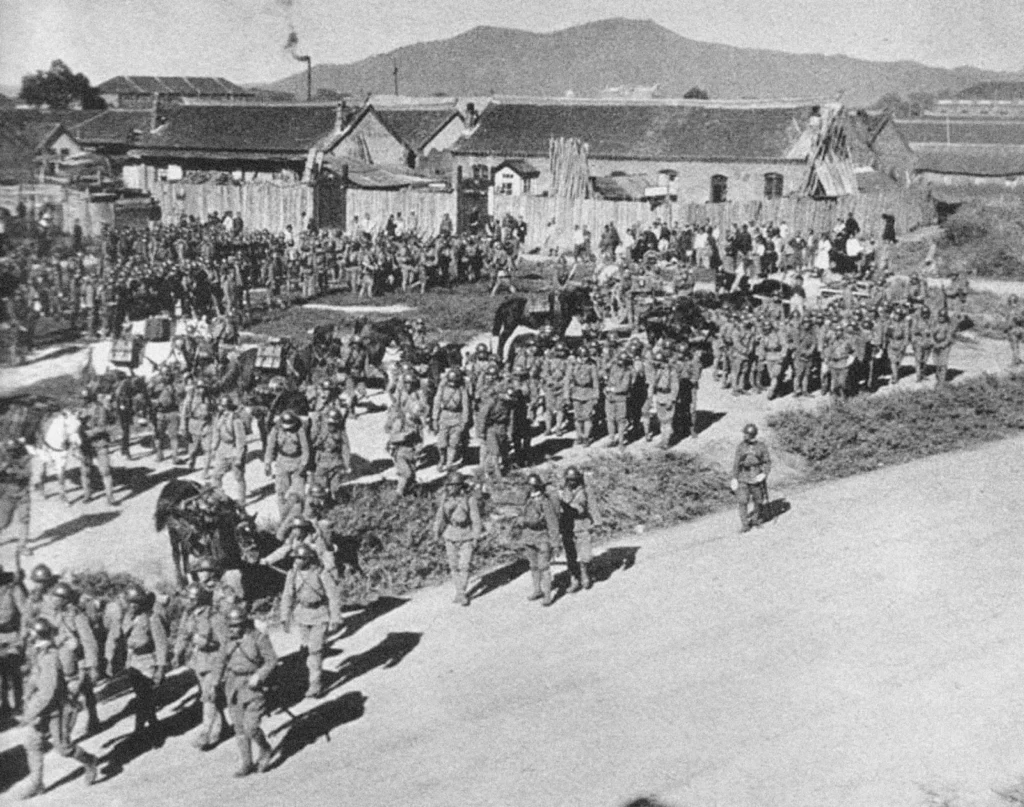
(These historical photos show Japanese troops advancing and occupying positions in Manchuria, 1931, illustrating early militarist expansion.)
Italy:
Under Mussolini, Italy invaded Ethiopia (Abyssinia) in 1935, using poison gas and aerial bombing against a weaker foe. The League’s mild sanctions failed; Italy annexed Ethiopia by 1936, boosting Mussolini’s prestige.
Germany:
Hitler pursued Lebensraum (living space) and Versailles reversal. Key steps included remilitarizing the Rhineland (1936), Anschluss (annexing Austria, March 1938), and pressuring Czechoslovakia over the Sudetenland (ethnic German region with fortifications).
Appeasement Policies
Britain and France, scarred by WWI and facing economic woes, adopted appeasement, conceding to aggressors to avoid war. Prime Minister Neville Chamberlain believed satisfying Hitler’s “limited” demands would bring peace.
The peak was the Munich Agreement (September 29 to 30, 1938): Hitler, Mussolini, Chamberlain, and French PM Édouard Daladier met; Czechoslovakia was excluded. They agreed Germany could annex the Sudetenland immediately, with promises of no further claims. Chamberlain returned, waving the agreement, declaring “peace for our time.” Hitler later called it a humiliation for the West but used it to seize the rest of Czechoslovakia in March 1939.
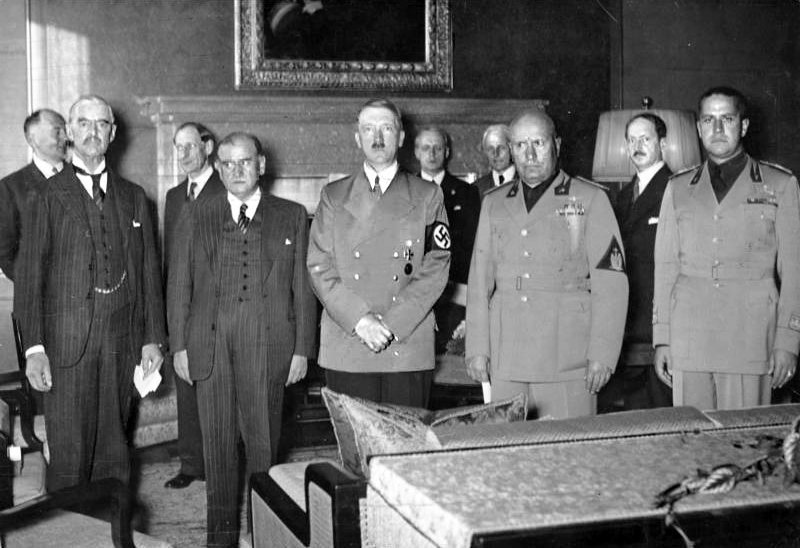
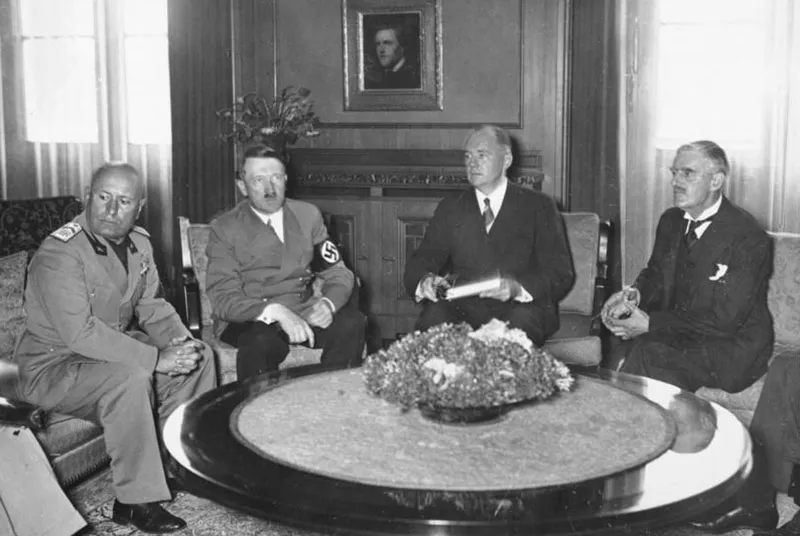
(Iconic Munich photos: Hitler with Chamberlain, Daladier, and Mussolini during negotiations, symbolizing appeasement’s high point and failure.)
Appeasement emboldened Hitler; when he occupied non-Sudeten Czechoslovakia, Britain/France realized it had failed and guaranteed Poland’s independence.
Nazi-Soviet Pact (Molotov-Ribbentrop Pact)
August 23, 1939: Germany and the USSR signed a non-aggression pact (public) and secret protocol dividing Eastern Europe into spheres of influence (e.g., Poland split, Baltics/Finland to USSR, parts to Germany). This cynical deal (ideological enemies allying) neutralized Soviet opposition to a German attack on Poland.
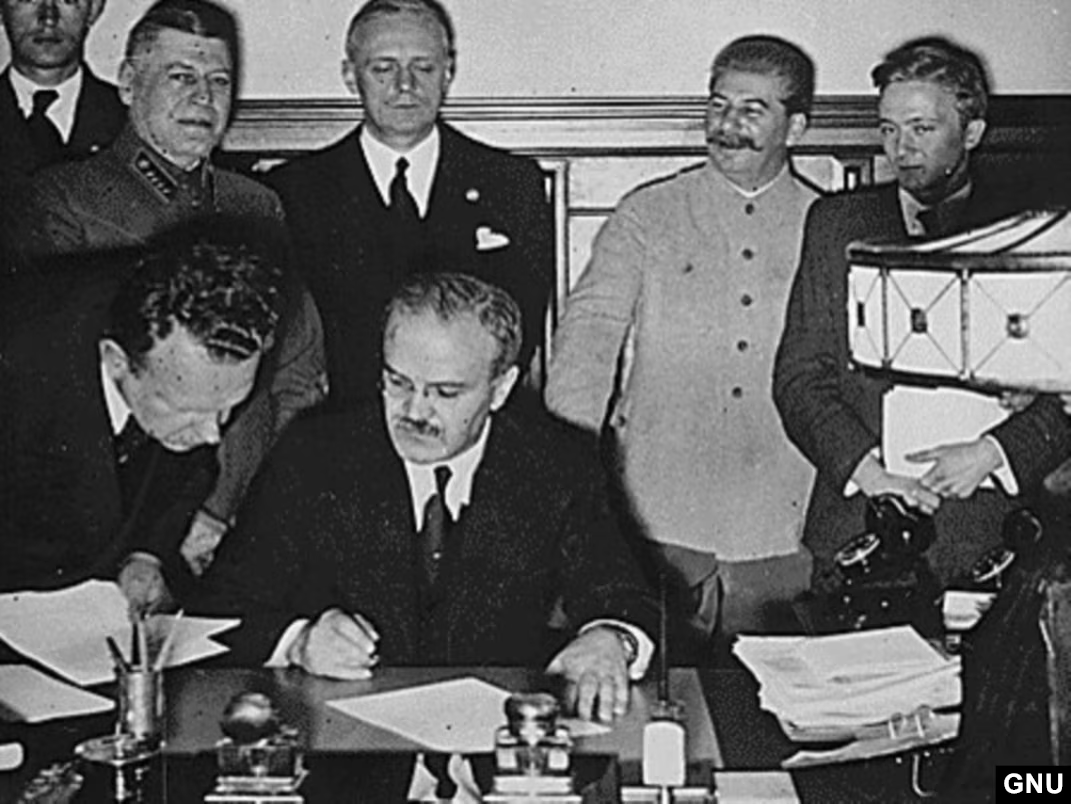
(Photos of the signing: Ribbentrop and Molotov, with Stalin in background, capturing the shocking realignment.)
Invasion of Poland – The Trigger
September 1, 1939: Germany invaded Poland using Blitzkrieg. Britain and France declared war on September 3, starting WWII in Europe. (USSR invaded eastern Poland September 17 per the pact.)
These events, aggressive grabs ignored or enabled by appeasement, plus the Nazi-Soviet deal, shattered the fragile interwar order, turning regional tensions into global war.
Activity 6: Appeasement vs. Confrontation
- Identify the key attributes of Appeasement and Confrontation in the table.
- Give your opinion on which you think is the better approach.
How World War II Was Fought (1939–1945) – Strategies, Technologies, and Total War
World War II was the first truly global total war: entire societies mobilized, economies redirected to destruction, and fighting spanned every continent except Antarctica. It pitted the Axis (Germany, Italy, Japan, plus minor allies) against the Allies (initially Britain/France, then USSR after 1941, USA after Pearl Harbor, plus Commonwealth nations, China, and others).
Key Strategies and Ways It Was Fought
- Blitzkrieg (“lightning war”): Germany’s signature early tactic. Used devastatingly in Poland (1939), France (1940), and early Soviet invasion (1941).
- Fast, coordinated attacks using tanks (Panzer divisions)
- Motorized infantry
- Dive bombers (Stuka)
- Close air support to break through lines and encircle enemies.
- Multi-front total war: Fighting on land, sea, air, and undersea across Europe, North Africa, the Atlantic, Pacific/Asia, and later the Eastern Front (biggest theater by far).
- Total mobilization:
- Governments conscripted millions
- Rationed food/fuel
- Shifted factories to war production (e.g., U.S. became the “Arsenal of Democracy,” producing 300,000 aircraft)
- Used women in factories
- Employed propaganda to sustain morale
- Civilians endured bombing, shortages, and occupation.
Major Technologies and Their Impact
- Tanks and armored warfare: German Panthers/Tigers vs. Soviet T-34 (best all-around tank) vs. Allied Shermans on Eastern and Western Fronts.
- Aircraft carriers and naval aviation:
- Shifted Pacific naval power
- U.S. carriers dominated after Midway (1942).
- Strategic bombing: Allied campaigns (RAF Bomber Command, USAAF) targeted German/Japanese cities and industry (e.g., Hamburg firestorm, Tokyo firebombing); Germany used V-1/V-2 rockets.
- Submarines (U-boats): Germany’s Battle of the Atlantic tried to starve Britain; Allied convoys, sonar, and code-breaking (Enigma) eventually won.
- Atomic bombs dropped by U.S. forcing Japan’s surrender:
- Hiroshima (Aug 6, 1945)
- Nagasaki (Aug 9, 1945)
Alliances and Coordination
- Allies coordinated via conferences (Tehran, Yalta, Potsdam), lended and leased aid (U.S. supplied Britain/USSR), and combined operations (e.g. D-Day).
- Axis coordination was weaker: Japan and Germany fought separate wars with little joint planning.
Quick Summary Timeline of How It Was Fought
- 1939 to 1940: Blitzkrieg victories (Poland, Denmark/Norway, Low Countries, France).
- 1940 to 1941: Battle of Britain (air war), North Africa campaign begins.
- 1941: Barbarossa (invasion of USSR)
- Pearl Harbor (U.S. enters).
- 1942 to 1943: Turning points on all fronts.
- 1944 to 1945: Allied invasions of Europe/Asia, atomic bombs end war.
Activity 7: WWII Technology Gallery – “Impact Ranking Challenge”
Evaluate WWII technologies/strategies
Rank the top 3 most decisive ones based on how they changed the war’s outcome.
There are 6 stations about WWII technologies. Each station include:
- Title of the technology/strategy
- Brief description
- Visual
- Primary source snippet
The 6 Stations
- Blitzkrieg (Lightning War)
- Strategic Bombing
- Aircraft Carriers & Naval Aviation
- Submarines / U-boats
- Atomic Bombs
- Tanks & Armored Warfare (Bonus / Combined with Blitzkrieg if needed)
- Rotate through stations. At each, read, view the image/quote.
- After all stations:
- Rank the 6 technologies/strategies from most decisive impact (1) to least (6). List them.
- Justify your top 3 in 1 to 2 sentences each. This can be written or explained verbally.
Turning Points and Global Scope
This part examines the war’s decisive moments that shifted momentum toward the Allies, the truly worldwide scale of the conflict (including colonial and non-European theaters), and the escalation of mass atrocities, especially the Holocaust, during the fighting.
Major Turning Points
These battles and campaigns marked the high-water mark of Axis success and the beginning of their defeat:
- Battle of Stalingrad (August 1942 to February 1943, Eastern Front): Germany’s 6th Army was encircled and destroyed by Soviet forces in brutal urban fighting. Over 1.1 million Soviet and 800,000+ Axis casualties. It marked the end of German advances into the USSR and the start of relentless Soviet counteroffensives toward Berlin.
- Battle of Midway (June 4 to 7, 1942, Pacific): U.S. Navy ambushed and sank four Japanese aircraft carriers (with code-breaking intelligence). This crippled Japan’s carrier fleet, shifted naval superiority to the Allies, and enabled the island-hopping campaign.
- D-Day / Normandy Invasion (June 6, 1944, Western Europe): Largest amphibious assault in history (156,000 Allied troops landed on five beaches). Opened a second front in Europe, liberated France by August 1944, and accelerated Germany’s collapse from two sides.
Other notable shifts:
- El Alamein (1942, North Africa) stopped Rommel
- Kursk (1943, Eastern Front) was history’s largest tank battle and a Soviet victory
- Leyte Gulf (1944, Pacific) destroyed much of Japan’s remaining navy
Global Scope and Colonial Involvement
WWII was fought on every inhabited continent except Antarctica:
- Pacific/Asian Theaters: Brutal island campaigns (Guadalcanal, Iwo Jima, Okinawa), Japanese occupation of Southeast Asia, China-Burma-India theater. Atrocities included Bataan Death March and comfort women system.
- Colonial troops: Millions from British Empire (Indian Army around 2.5 million, largest volunteer force ever; African, Caribbean, ANZAC units), French colonies (Free French, Senegalese Tirailleurs), and others fought in Europe, Africa, and Asia. Their contributions were vital but often under-acknowledged postwar.
- North Africa & Mediterranean: Axis vs. Allies in deserts (El Alamein, Operation Torch); Italian campaigns (Sicily, mainland Italy).
- Home fronts worldwide: Civilians in occupied Europe/Asia endured forced labor, famine (e.g., Bengal 1943), and resistance movements.
Holocaust Escalation During the War
The systematic genocide intensified as the war progressed:
- Pre-war persecution (Nuremberg Laws 1935, Kristallnacht 1938) turned into mass murder after 1941 invasion of USSR (Einsatzgruppen shootings).
- Wannsee Conference (January 1942) formalized the “Final Solution.”
- Death camps (Auschwitz-Birkenau, Treblinka, Sobibor) operated at peak 1942 to 1944; gas chambers, forced labor, medical experiments.
- More than 6 million Jews murdered (two-thirds of European Jewry), plus millions of Roma, disabled, political prisoners, homosexuals, Jehovah’s Witnesses, and others.
- War provided cover: deportations disguised as “resettlement,” records destroyed, and resources diverted amid fighting. Liberation of camps (e.g., Auschwitz by Soviets, January 1945) revealed the scale.
Activity 8: Google Earth “WW2 Turning Points”
Explore the Google Earth Tour and add a piece of info to each place.
Google Earth “WW2 Turning Points”
Worlds in Flames Rubric
Interwar & WW2 Assessment Rubric – Activity-Based
| Activity | 1 point (Needs Improvement) | 2 points (Developing) | 3 points (Good) | 4 points (Excellent) |
| Activity 5: Timeline of Interwar Events(9 events in table or visual timeline) | Only 1–3 events included, many wrong or missing, no order | 4–6 events, some order & accuracy, but gaps/errors | 7–8 events correct, good order, basic descriptions | All 9 events correct, in order, clear descriptions, shows progression |
| Activity 6: Appeasement vs. Confrontation(Table + personal opinion) | Table very incomplete/wrong, no opinion or no reasons | Table has basic points but missing key attributes, opinion weak or unsupported | Table covers main attributes accurately, opinion has some history reasons | Table complete & accurate, opinion clear, evidence-based, mentions both sides |
| Activity 7: Tech Gallery – Impact Ranking(6 stations + rank top 3) | Few/no station notes, no ranking or no reasons | Notes from 3–4 stations, basic ranking, limited reasons | Notes from 5–6 stations, clear ranking with good reasons for top 3 | Full notes from all 6, thoughtful ranking, strong reasons tied to war outcome |
| Activity 8: Google Earth WW2 Turning Points(Visit + add 1 fact per place) | Few/no places visited, no or wrong added facts | Some places visited, basic or inaccurate facts added | Most key places visited, correct & relevant facts added | All major places visited, accurate, important facts added, shows understanding |